
About me
Getting ordained
What ordination in the Triratna Buddhist Order actually means, why I asked for it, and how a new name - Sīlavāpi - sits alongside a life and career in open source.
In June 2026 I was ordained into the Triratna Buddhist Order on an 11 week ordination retreat in the mountains of Aragón, Spain. I received the name Sīlavāpi, which means ‘she who is a lake of virtuous conduct’. Read more about the name in my ‘introducing Sīlavāpi’ blog post.
For many people outside Buddhist circles, ordination can sound mysterious, or like a step that takes you out of ordinary life. In Triratna, it has a very particular meaning which is both radical and very down to earth. This page is my attempt to explain what ordination is, why I chose it, and how it sits alongside my work and life in the world.
What ordination means in Triratna
In Triratna, the central act of being a Buddhist is Going for Refuge to the Three Jewels:
- the Buddha - the ideal of Enlightenment
- the Dharma - the teachings and path that lead to Awakening
- the Sangha - the community of those who practise and embody the path
Ordination is a public, formal recognition that Going for Refuge has become the central, organising principle of your life. It is a commitment to put the Three Jewels at the centre of your mandala, and to gradually align everything else in your life around that choice.
A few important things to say:
- Ordination in Triratna is not in itself monastic. We do not have a sharp divide between monks and nuns on one side and lay people on the other. Many Order members live and work in ordinary contexts - in my case, within the open source tech world, living with my partner and cats.
- Ordination is a recognition of your effectively placing the three jewels at the heart of your life, not about status. It is saying, for the rest of this life, and perhaps beyond, that you are committing yourself to the path of transforming greed, hatred and delusion into generosity, loving kindness and wisdom.
- Ordination is also about relationship and lineage. You are ordained by a preceptor, in the context of a community, into a living lineage that goes back to the Buddha.
One thing that is distinctive about Triratna is that women ordain women and men ordain men. The first person ever ordained into the Triratna Buddhist Order was a woman. There is also now a path to ordination being developed for people who do not fit within the gender binary, with the first ordination on that pathway taking place this year. This feels important and I’m hopeful that it will shape the future of a more inclusive Order.
Why I asked for ordination
I first came across Triratna at university in 2001. It was not until a young women’s retreat at Taraloka a few years later, though, (which I was invited to via Facebook - thanks Singhamati!) that something really clicked. Sitting in a shrine room with other women who shared the same sense that there was another way to live, I had the strong experience that all the pieces of the jigsaw were finally coming together.
From that point I knew I wanted to commit my life to this path, even though I also knew I would have plenty of personal stuff to work through along the way - trust issues, health challenges, the usual human mix.
As the years unfolded, several things deepened my Going for Refuge:
- the centrality of friendship and spiritual community
- living through a major health crash with the Dharma and Sangha as lifelines
- discovering the precepts as a living, practical ethical training
- learning that ethics, work, leadership and technology are not separate from spiritual practice but part of its heartland
Ordination, for me, is a natural deepening of that process. It is saying yes more fully and explicitly, for the rest of this life.
The path to ordination
People arrive at Triratna in different ways. Some come to a lunchtime meditation, some attend a beginners class, some find us online. From the moment we first engage we are encouraged to practise the five precepts in a simple, initial way and to explore meditation and the Dharma for ourselves.
At a certain point, some of us realise that Buddhism is not just something we are interested in, but the way we want to live our lives. In Triratna, that point is often marked by becoming a mitra - which simply means friend. Becoming a mitra is saying:
- I consider myself to be a Buddhist
- I wish to practise within the Triratna Buddhist Community
- I wish to be part of this sangha
From there, practice usually deepens through:
- regular meditation and Dharma study
- more conscious practice of the precepts as training principles
- involvement in sangha life - friendships, retreats, service
- exploring Going for Refuge more and more as a central life orientation
When someone asks for ordination, they enter a period known as ‘training for ordination’. This is not a formal course with modules that you tick off. It is more like being woven deeper into a network of practice and support: study groups, kalyāṇa mitratā (spiritual friendship), retreats and the support of places like Tiratanaloka and Padmaloka - the UK ordination training centres for women and men, respectively. There are also online study groups for folks who, for whatever reason, can’t make it to retreats in-person.
Ordination retreats
The ordination retreat is an important part of the process, but it is not a stand alone event dropped into an otherwise ordinary life. It is the culmination of years of practice and reflection, and also a beginning.
In Triratna there are several shapes of ordination retreat:
- For women - an 11 week retreat at Akashavana in Spain, and also an option for a 2 week ordination retreat at Akashavana .
- For men - an 11 week retreat at Guhyaloka in Spain, also 4 week options.
- There is also a 2 week ordination retreat option in the UK for those where the longer, off grid retreats abroad are not possible due to health, caring commitments or other significant conditions.
- In some cases, people are ordained in their local context if none of these retreat options are practicable.
My own ordination took place on the 11 week retreat at Akashavana, a women’s retreat centre high in the mountains. It was an intense and beautiful experience, but it made sense only because of all the conditions that had led up to it over the previous sixteen years. I’m incredibly grateful to every single person who helped make it possible - from the folks who took up my work so I could take a sabbatical to my partner for holding the fort while I was away, friends and family who contributed in financial or practical ways and of course our amazing team and support community who made it all possible.
What changes after ordination and what does not
The most visible change is my name. Through my ordination I received the name Sīlavāpi. For me this represents a spiritual death and rebirth: Ruth, as an identity, falls away to make space for a new being whose life is more explicitly aligned with the precepts and the Three Jewels.
I will use the name Sīlavāpi in all contexts - work, personal life and online. It will take time for people and systems to catch up, and that is ok. The deep meaning of the name is something I intend to live into for the rest of my life.
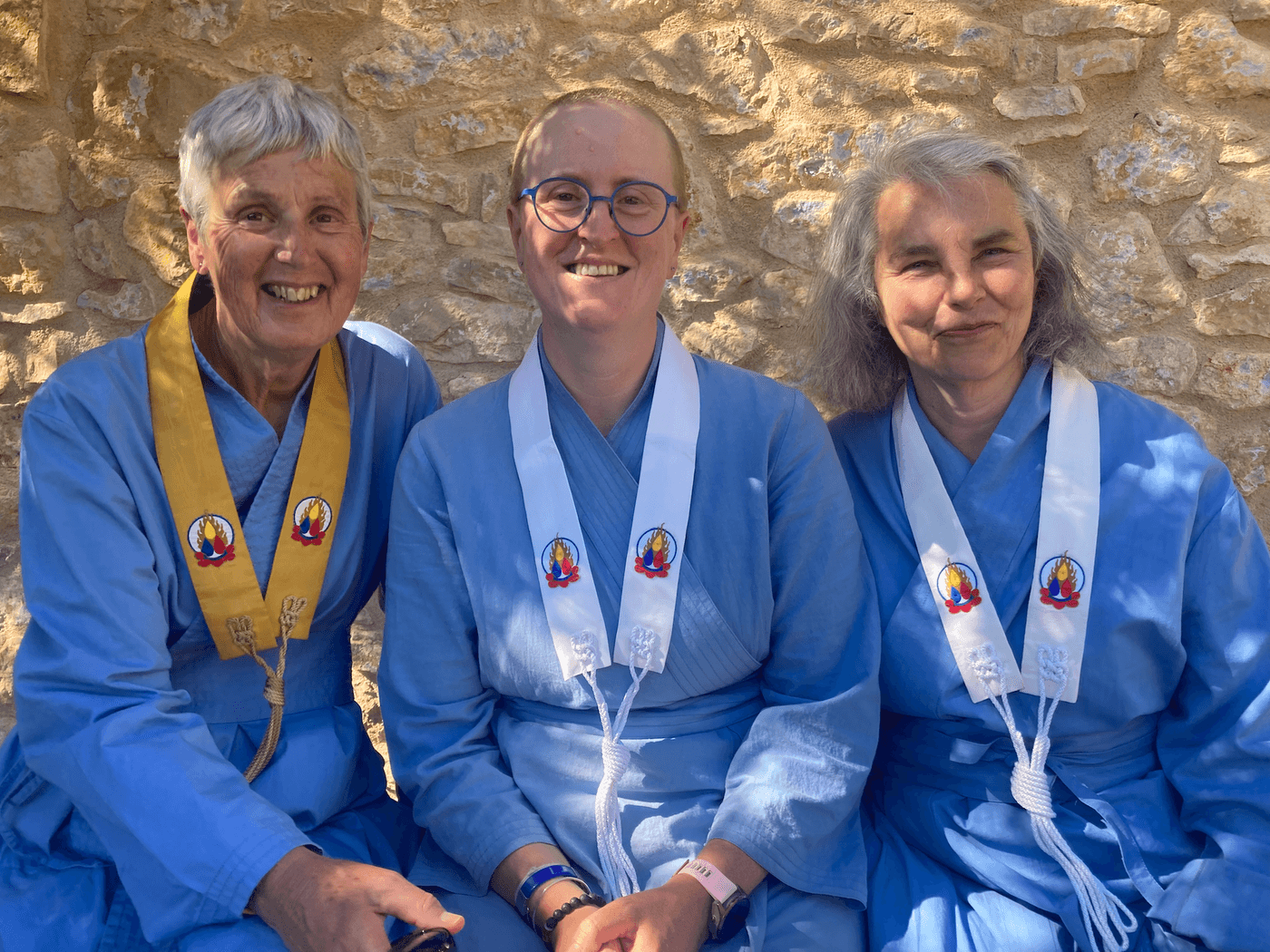
Another outward sign is the kesa, a piece of white cloth joined by white rope tied in a knot - a symbolic Buddhist robe worn around the neck. Also, at the moment, my choice to experiment with wearing robes more often than is usual in our movement. For me this is a way of exploring simplicity and visibly remembering my commitment, even while working in a very non monastic environment.
What has not changed is that:
- I still work in the tech world, leading the global Mautic community.
- I still live with my partner (and our two cats) and pay a mortgage.
- I still run, swim, cycle, drink (decaf) coffee, and get over-excited about good documentation.
Ordination does not take me out of the world. It changes the basis on which I live in it. It is an inner shift that, I hope, gradually expresses itself in how I relate, lead, speak and act.
How ordination shapes my work
One of the reasons I write about ethics and leadership in open source is that I really do not see my Buddhist life and my work as separate.
Ordination in Triratna involves taking the ten precepts as vows. These include:
- abstaining from causing harm and cultivating loving kindness
- abstaining from taking the not given and cultivating generosity
- abstaining from sexual misconduct and cultivating stillness, simplicity and contentment
- abstaining from false, harsh, frivolous and slanderous speech, and cultivating truthful, kind, meaningful and harmonising speech
- transforming covetousness, hatred and wrong views into tranquillity, compassion and wisdom
For me, these are not religious rules divorced from ordinary life. They are the ethical backbone of how I want to lead in open source: how I handle conflict, how I respond to pressure, how I think about funding and sustainability, how I speak about others, and how I hold my own role.
Ordination is a reminder, in a very direct way, every time someone calls my new name, that my work in the world is part of my practice, not a distraction from it.
Frequently asked questions
Are you a nun now?
No. In Triratna, ordination does not automatically mean monastic renunciation. Some Order members do live very simply in communities or retreat centres. Others, like me, live and work in more typical householder contexts. What we share is a common commitment to the Three Jewels and the precepts.
Are you still working in tech and on Mautic?
Yes. I am still project lead for Mautic and still very much involved in open source. Ordination deepens my sense of responsibility to bring as much clarity, kindness, honesty and wisdom as I can into that work.
Does this mean you are going to be more religious at work?
Not in the sense of trying to convert anyone. It does mean that my decisions and leadership are increasingly guided by my ethical and spiritual commitments. My hope is that this makes me a better collaborator and leader, not a more dogmatic one.
I am interested in knowing more about Buddhism and/or ordination - what should I do?
If you are curious about ordination in Triratna, a good next step is:
- Start attending your local Triratna centre or group regularly.
- Talk to Order members about their experience.
- Become a mitra if that feels right.
- Go on retreats
You can also find more information at thebuddhistcentre.com.
Final thoughts
Getting ordained is not a finish line. It is a deepening of a lifelong commitment to live ethically, to grow in wisdom and compassion, and to be of benefit where I can.
If you have questions - whether you are a Buddhist, a curious friend, or a slightly bewildered colleague in tech - feel free to reach out. I might not always have neat answers, but I am very happy to be in the conversation.